A drive-thru that runs itself in the rain.
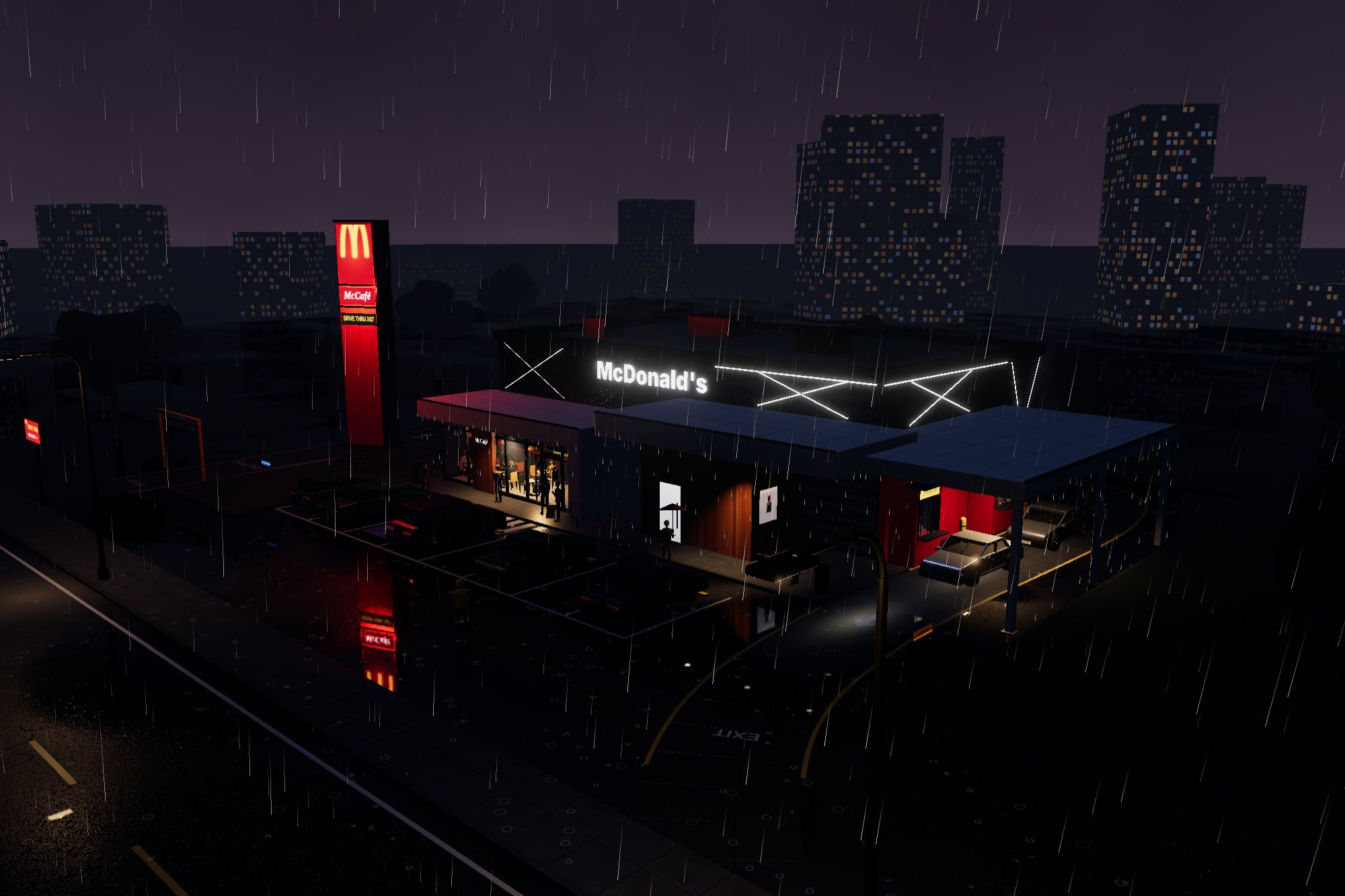
A drive-thru restaurant on a wet night — queuing cars, walking customers, rain on every surface — simulated live in the browser.
The brief
Most architectural visualisation shows a building at noon with nobody in it. A drive-thru is the opposite kind of building: it is defined by what moves through it, and it is busiest at night, in weather, when the signs are doing the work.
So the brief was a scene that runs rather than poses — a rainy night with the queue moving, people coming and going and the wet ground doubling every light — in a single page, built from code, and readable in English or Chinese at the press of a button.
Design decisions
The queue is simulated. Each car follows the lane as a spline, keeps its distance from the car ahead, brakes on a curve it can actually stop in, waits at the order board, the pay window and the pickup window, and gives way to anyone crossing. Brake lights and indicators follow what the car is doing.
Rain is drawn in one call: 30,000 streaks are wrapped around the camera in the vertex shader, discarded under the canopies, and brightened by the eight nearest light sources. Splashes, canopy drips and lightning are three more small shaders.
Nothing is downloaded but code. Asphalt, cladding, timber, stone, concrete, grass and glass are painted on canvas at load, each with a normal map derived from its own height field. Signage is drawn the same way, so switching language redraws every sign, menu board and number plate.
Outcome
A scene that holds attention without a script: six to eight cars working through the lane, customers walking in and out, nine camera presets from the dining room to a car's rear bumper, and a live count of the queue. The building, the site and the city are merged by material at load, so the static scene costs a few dozen draw calls rather than thousands.
A concept project designed in-house, not a client engagement. Figures describe the delivered design system — components, screens, scope and duration — not commercial results.
The concept is live and open to read.
The original build opens in a new tab, with its own case study page alongside it.
Start with the two-week diagnostic.
A 60-minute review, then a fixed-fee fortnight. You leave with a costed roadmap and no obligation to continue.
Auckland