Light is the model.
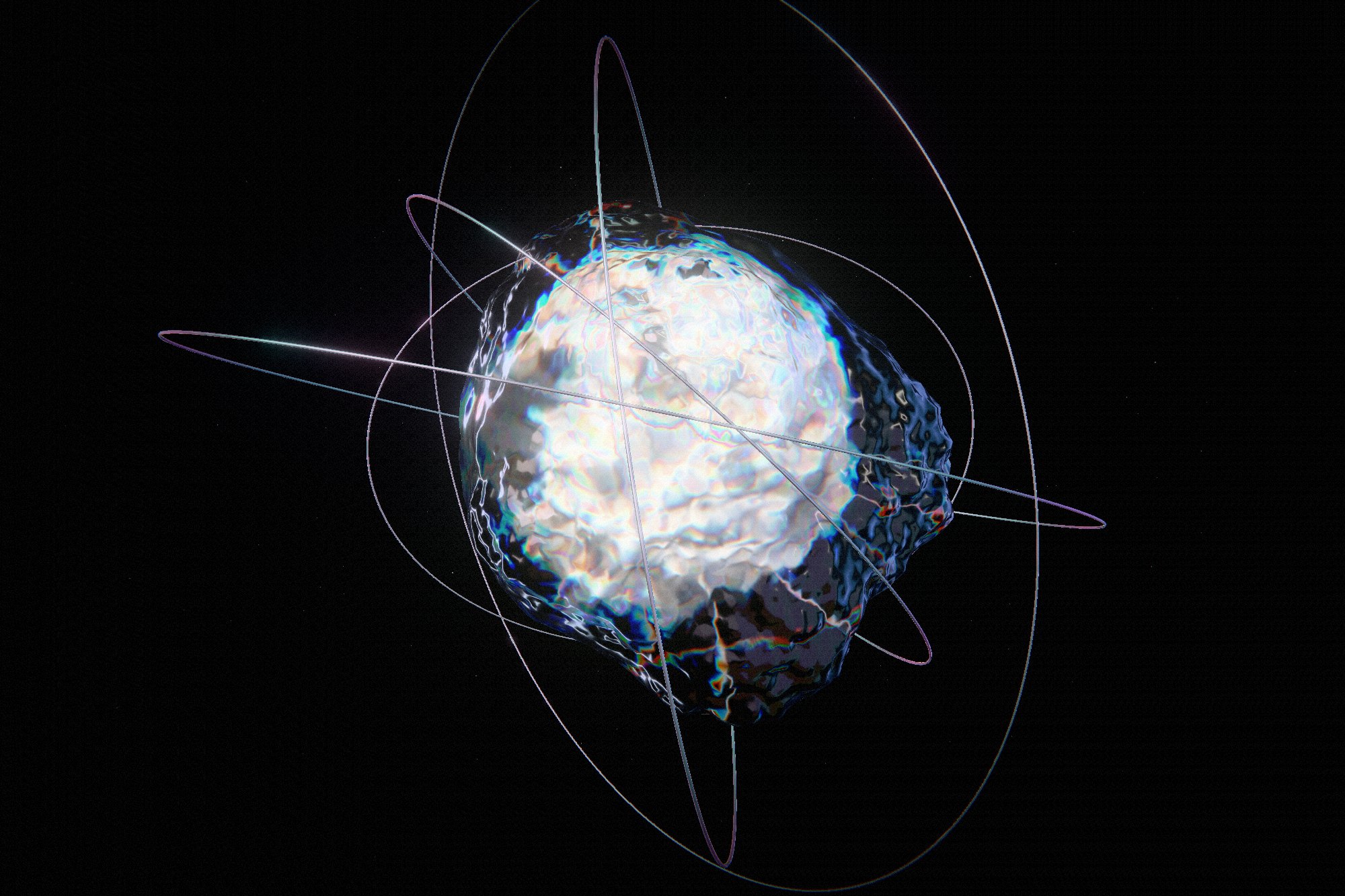
A dispersive glass specimen rebuilt as a live scene, where the spectrum comes out of refraction instead of a picture of it.
The brief
The plate to match was a mineral body inside thick glass, its edges broken into spectra and thin orbits crossing in front and behind. Producing the shape was the easy half: exported as a model and dropped into a page, it read as a grey lump. Everything convincing about the reference lived in the lighting and the refraction, and neither of those survives an export.
So the work was not to reproduce a picture but to rebuild the conditions that make it — something that holds up while it turns, on a viewport of any shape, without shipping a single asset.
Design decisions
Dispersion is physical here. The core is an opaque mesh, so it lands in the renderer's transmission backdrop and the shell refracts it per wavelength — the fringe moves correctly as the body turns, which a screen-space effect never does.
A procedural environment does the lighting: a dark room with a few broad panels and three narrow bright strips, pre-filtered into an environment map. The strips are what smear into spectra; without them glass has nothing to bend.
Separate membranes for the wings read as grey plastic against a dark ground, so they were dropped. The shell's displacement field grows lobes instead, keeping one continuous refracting surface out to the silhouette.
Outcome
About forty kilobytes of hand-written code over a vendored renderer, generating its own geometry, lighting and grain at load. It survives being turned, resized and re-seeded, drops into any page as a module, and hands the GPU back when the section unmounts.
A concept project designed in-house, not a client engagement. Figures describe the delivered design system — components, screens, scope and duration — not commercial results.
The concept is live and open to read.
The original build opens in a new tab, with its own case study page alongside it.
Start with the two-week diagnostic.
A 60-minute review, then a fixed-fee fortnight. You leave with a costed roadmap and no obligation to continue.
Auckland