A planet has to be recognisable.
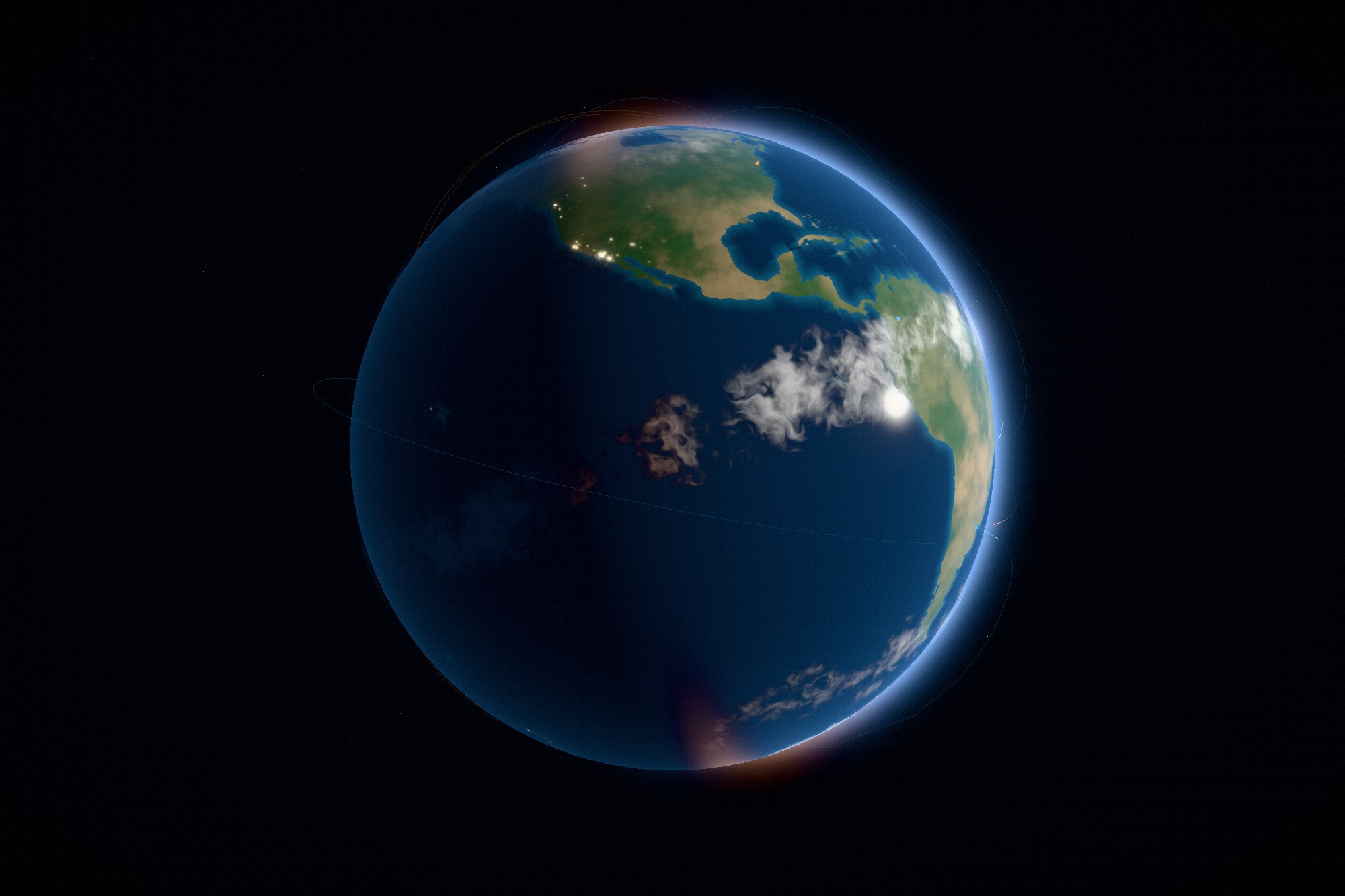
A lit globe with weather, night cities and traffic, built from two public data files and a great deal of arithmetic.
The brief
A globe with weather, sunlight and cities visible on the night side — and it had to carry the homepage, not just a case page. That second half set the constraints: it has to hold up at a glance, survive being dragged, and cost a visitor nothing before the first sentence of the page has rendered.
It also had to stay honest to how the rest of this library is built. Generating a planet outright was not an option, so the compromise is narrow and stated plainly: shape comes from data, everything else is made.
Design decisions
Natural Earth coastlines at 1:50m, simplified to a tenth of a degree, and every settlement over 200,000 people. From those: a land mask, a distance-to-land shelf channel that turns coasts turquoise, latitude-banded biomes, and city lights scaled by the log of population.
The cloud deck is baked on the GPU in one pass — fractal noise sampled on the sphere each pixel maps to, so it wraps at the antimeridian and does not pinch at the poles — then banded wet at the equator, dry at the horse latitudes, stormy in the mid-latitudes.
The surface shader reads the deck twice, once underfoot and once offset along the sun, so the clouds throw a shadow on the ground beneath them.
Outcome
A globe that reads as Earth at a glance: weather moving at its own rate, cities coming on as the terminator passes, a limb that glows because air thins rather than because a sphere was drawn slightly larger. It runs the same code in the case page and the homepage hero.
A concept project designed in-house, not a client engagement. Figures describe the delivered design system — components, screens, scope and duration — not commercial results.
The concept is live and open to read.
The original build opens in a new tab, with its own case study page alongside it.
Start with the two-week diagnostic.
A 60-minute review, then a fixed-fee fortnight. You leave with a costed roadmap and no obligation to continue.
Auckland